Angola’s energy infrastructure presents a sharp contrast. The country is one of sub-Saharan Africa’s major oil producers and has built large offshore production systems, export terminals, hydropower stations, and urban power networks. Yet much of the population remains outside a reliable national electricity system.
This contrast defines Angola’s infrastructure challenge. Generation capacity has increased considerably, especially through hydropower, but the ability to transmit, distribute, meter, and sell that electricity has not expanded at the same pace. Large amounts of power are concentrated in northern and central systems, while remote provinces and rural communities may still depend on isolated diesel generation or have no formal supply.
The country therefore needs to connect infrastructure that has often developed as separate systems: offshore oil, LNG and refining assets, large river-based power stations, regional transmission networks, urban distribution systems, and rural electrification projects.
Hydropower Has Expanded Faster Than the National Grid
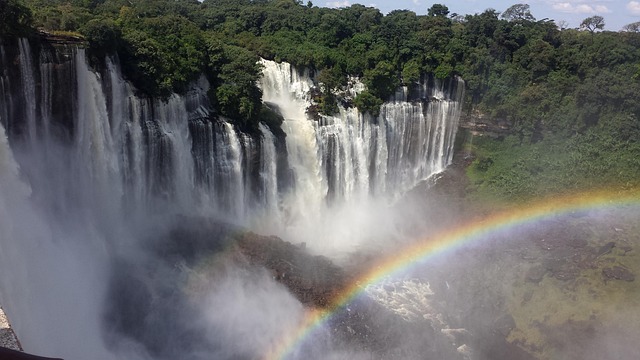
Hydropower is the core of Angola’s electricity system. The country’s major rivers provide strong generation potential, and large dams have allowed it to increase available capacity without depending entirely on oil-fired or diesel generation.
The 2.07-GW Laúca hydropower station on the Kwanza River is the most important recent addition. It reached full capacity in 2023 and significantly strengthened electricity supply in the northern system. The Capanda and Cambambe plants also form part of the Kwanza River generation corridor.
Caculo Cabaça is intended to extend this hydropower expansion further. With planned capacity of more than 2 GW, it is one of Africa’s largest hydroelectric projects. Its value, however, will depend on the transmission system being able to move the electricity toward demand centers.
Angola’s power system has historically been divided into northern, central, eastern, and southern networks rather than operating as one fully integrated national grid. The northern system contains the largest concentration of hydropower and serves Luanda, where population, public services, and commercial demand are concentrated.
This creates a geographic imbalance. Angola may have significant generating capacity in one region while businesses and households elsewhere continue to face shortages. Building another power station does not solve this problem unless high-voltage transmission, substations, and distribution lines are developed at the same time.
Hydropower also creates operational exposure to rainfall and river conditions. Gas-fired generation, solar plants, storage, and regional power trade can help diversify the system and improve resilience during periods of weak water availability.
Transmission Is the Missing Link in Angola’s Power Strategy
Transmission development is the most important structural issue in Angola’s electricity sector. The country needs to link its regional systems, extend high-voltage lines into underserved provinces, and prepare for electricity trade with neighboring countries.
The expansion of transmission toward southern Angola is especially significant. Southern provinces have often relied on isolated and costly diesel generation. A stronger connection to the national system would allow hydropower and other large-scale generation to replace some of that fuel use.
The planned Angola–Namibia interconnector could also link Angola more closely to the Southern African Power Pool. This would create opportunities to import electricity when needed and export surplus hydropower when domestic conditions allow.
Regional trade could improve the commercial value of Angola’s dams, but participation requires more than a cross-border power line. Angola needs reliable dispatch systems, clear market rules, capable utilities, stable payment arrangements, and transmission infrastructure that can carry electricity from generating areas to the border.
The national dispatch and system-control network also requires modernization. Better supervisory control, communications, forecasting, and metering would allow operators to manage power flows more efficiently and reduce outage duration.
A proposed transmission expansion supported by private capital focuses on strengthening capacity toward southern provinces and enabling regional integration. This reflects a wider change in policy: the government increasingly recognizes that public investment alone may not be sufficient to finance the network required by a large and geographically dispersed country.
Electricity Access Remains the Main Measure of Progress
Angola’s infrastructure cannot be judged only by installed megawatts. Electricity access remains limited, with a large difference between Luanda and other urban centers, smaller towns, and rural communities.
Many communities are located too far from existing transmission and distribution lines for conventional grid extension to be immediately economical. In those areas, mini-grids, solar systems, and hybrid generation may be more practical than waiting for the main network.
In cities, the problem is often different. Households may be physically close to electricity infrastructure but lack formal connections, reliable metering, or consistent service. Informal connections and weak billing systems contribute to commercial losses and reduce utility revenue.
The World Bank-supported Electricity Sector Improvement and Access Project is designed to address several of these problems. Its targets include new household connections, thousands of kilometers of distribution construction or rehabilitation, new transformers, smart meters, substation upgrades, and improvements to national dispatch.
The project also aims to reduce overall system losses. Losses weaken the entire electricity value chain because generation does not translate into equivalent billed consumption. Technical losses arise from overloaded or outdated equipment, while commercial losses are linked to metering, billing, collection, and unauthorized use.
Improving revenue collection is therefore an infrastructure issue as well as a financial one. Utilities that cannot recover costs struggle to maintain equipment, purchase spare parts, expand service, or attract private investment.
Oil Infrastructure Remains Economically Dominant
Electricity infrastructure is central to development, but oil infrastructure remains the foundation of Angola’s export economy. Most crude production comes from offshore fields connected to floating production systems, subsea equipment, pipelines, storage facilities, and marine export terminals.
This offshore model differs from the land-based pipeline systems found in many producers. Angola’s deep-water fields rely heavily on floating production, storage, and offloading vessels. These facilities process oil at sea and transfer it to tankers for export.
Cabinda and the Lower Congo Basin remain important petroleum areas, while deep-water blocks farther offshore have supported major international investment. Sonangol, the national oil company, participates across the sector alongside international operators.
Angola has historically exported crude while importing a large share of its refined petroleum products. This has created a costly imbalance for a major oil producer. Domestic refinery development is intended to reduce that dependence.
The Cabinda refinery is designed to begin at approximately 30,000 barrels per day, with a possible later expansion. Larger proposed projects at Lobito and Soyo are intended to increase domestic processing capacity further, although financing, construction schedules, and project structures have changed repeatedly.
Refinery infrastructure alone will not eliminate import dependence. Angola also needs crude supply arrangements, product storage, road and port distribution, maintenance capacity, and commercially sustainable operations.
LNG and New Gas Supply Add Another Infrastructure Corridor
The Angola LNG facility at Soyo gives the country an established gas-processing and export center. The plant was originally developed largely to use associated gas from offshore oil production that might otherwise have been reinjected or flared.
The start of production from the Quiluma field in 2026 marked an important change because it is part of Angola’s first major non-associated gas development. Rather than relying only on gas produced alongside crude oil, the New Gas Consortium is developing fields specifically for gas supply.
This can improve feedstock availability for Angola LNG and support a more stable gas industry. It may also create opportunities for domestic gas use in power generation, fertilizers, petrochemicals, and industrial development.
Soyo is therefore becoming more than an LNG export location. It is an integrated gas corridor linking offshore production, processing, liquefaction, marine infrastructure, and potential domestic demand.
Gas-fired power can complement hydropower by providing generation when river conditions are weaker or demand rises quickly. However, domestic use will require pipelines and commercial agreements that connect gas supply with power stations and industrial customers.
Reform Must Turn Large Assets Into Reliable Service
Angola reorganized its electricity sector into separate generation, transmission, and distribution companies, including PRODEL, RNT, and ENDE. This was intended to improve accountability and operational focus across the power value chain.
A further amendment to the General Electricity Law in 2025 sought to attract more private investment and improve sector efficiency. The reform is important because Angola’s expansion requirements are too large to depend indefinitely on state financing and oil revenue.
Private investors, however, will require predictable tariffs, enforceable contracts, reliable payment, transparent procurement, and confidence that electricity can be transmitted and sold. The performance of the distribution system is therefore directly connected to the ability to finance new generation and transmission.
Angola has already built energy assets of regional importance. Its next infrastructure phase must connect them more effectively. Hydropower must reach underserved provinces. Urban networks must convert nearby residents into formal customers. Offshore gas must support both LNG exports and domestic industry. Refining projects must move from construction plans into reliable production.
The decisive measure will not be the size of individual dams, refineries, or offshore projects. It will be whether Angola develops an integrated system capable of delivering affordable energy across the country while using surplus resources to support industrial growth and regional trade.